
Bacterial Vaginosis
One of the most frequent "non-cellular" findings on cytology: a shift in the balance of bacteria that normally live in the vagina. It is not a precancerous lesion, has no relationship with HPV, and is very treatable.
What it looks like under the microscope.
Cervical cytology, Papanicolaou stain.
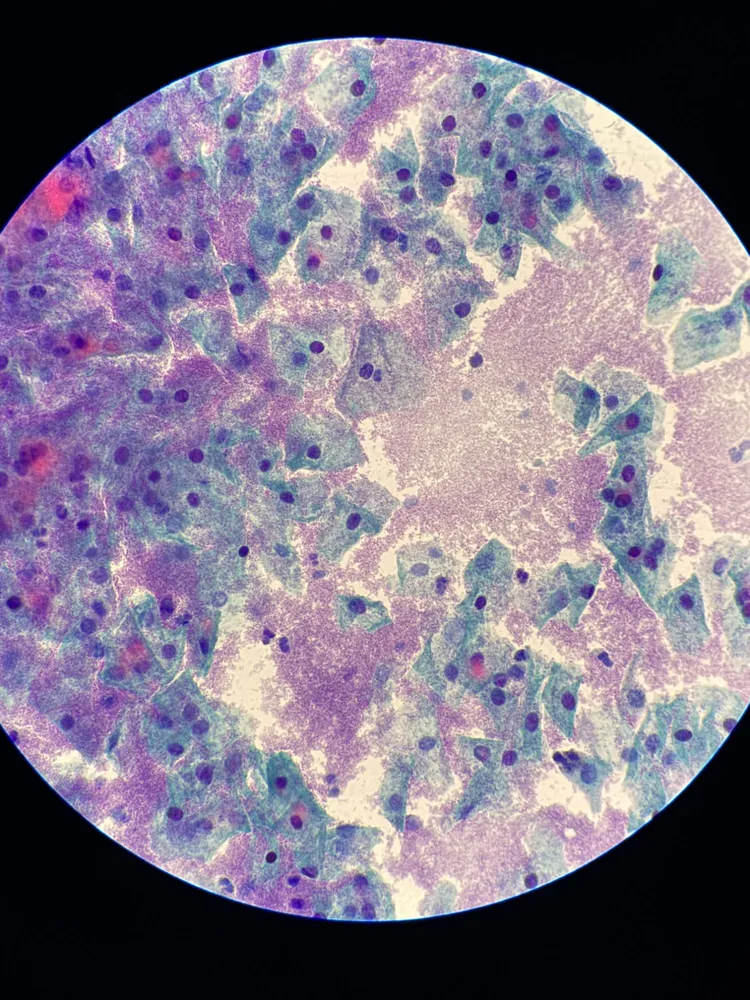
Clue cells: squamous cells whose cytoplasmic border appears blurred, granular and "moth-eaten" due to the dense adherence of coccobacilli to their surface. The background, instead of showing the long, clean bacilli of normal lactobacilli, appears covered by a thin, granular layer of mixed bacteria — the so-called flora shift.
Your result, explained without fear.
Is it serious?
No. It is a very common finding, it is not cancer, it is not a precancerous lesion, and it has no relationship with the human papillomavirus (HPV). It is treated with antibiotics and usually resolves without complications.
Why did this happen to me?
The vagina has its own balance of bacteria, normally dominated by lactobacilli that maintain a protective acidic environment. Bacterial vaginosis occurs when that balance is disrupted and other bacteria (which also normally live there) grow more than usual. It is not a sexually transmitted infection in the classic sense, and it can appear regardless of sexual activity.
What symptoms does it cause?
The most typical is a thin, greyish-white discharge with a "fishy" odor that is often more noticeable after intercourse. But up to half of cases have no symptoms at all, and are discovered precisely on a routine cytology like this one.
What happens now?
Your doctor or midwife can confirm it with an exam and, if appropriate, treat it with antibiotics (usually metronidazole or clindamycin). If you have no symptoms, mention it to your professional anyway so they can decide whether treatment is needed in your case.
Findings and clinical correlation.
Cytomorphologic criteria: clue cells — superficial/intermediate squamous cells with obscured, granular-appearing cytoplasmic borders due to dense adherence of coccobacilli to their surface. The background shows a flora shift: replacement of the thick bacillary pattern of Lactobacillus spp. by a mixed, fine, granular population of coccobacilli, with scant accompanying inflammatory response compared with trichomoniasis or candidiasis.
Bethesda category: reported within the Organisms section (not as a squamous cell abnormality) — "shift in flora suggestive of bacterial vaginosis," alongside Trichomonas vaginalis, fungal organisms morphologically consistent with Candida, and changes consistent with herpes simplex virus as other reportable findings within this same category.
Microbiology: polymicrobial dysbiosis — not a single pathogen. The organisms most frequently implicated include Gardnerella vaginalis, Atopobium vaginae, Prevotella species and Mobiluncus species, among other anaerobes, replacing the usual predominance of hydrogen peroxide-producing lactobacilli.
Reference clinical diagnosis: Amsel criteria (3 of 4: homogeneous discharge, vaginal pH >4.5, positive amine/whiff test, ≥20% clue cells on wet mount) or Nugent score on Gram stain, considered the reference standard. The cytologic finding on Pap smear is suggestive but does not replace these diagnostic criteria.
The balance of the vaginal flora.
Why this shift happens, without needing a single "germ" to cause it.
The vagina is not a sterile environment: it normally hosts a community of microorganisms (the flora or vaginal microbiota), usually dominated by Lactobacillus species. These bacteria produce lactic acid and maintain an acidic pH (between 3.8 and 4.5) that acts as a natural barrier, making it harder for other microorganisms to overgrow.
Bacterial vaginosis appears when that balance breaks down: lactobacilli decrease and a varied group of bacteria — mostly anaerobes, such as Gardnerella vaginalis and others — comes to predominate. It is, by definition, a polymicrobial process: there is no single "causative" microorganism as in a classic infection.
Unlike a sexually transmitted infection, bacterial vaginosis can appear in people without recent sexual activity. Factors that have been identified as increasing its frequency include vaginal douching, having new or multiple sexual partners, not using condoms, smoking, or having an intrauterine device (IUD) — although it also occurs without any of these factors present.
It has no relationship with the human papillomavirus (HPV) nor with the development of precancerous lesions of the cervix — it is a finding of an entirely different nature from LSIL, even though both can appear on the same cytology.
What is the "Bethesda System"?
It is the standardized system used by laboratories around the world to report cervical cytology results, so that a result means the same thing at any center. In addition to categories of cellular abnormalities (such as LSIL), it includes a specific Organisms section, where findings such as bacterial vaginosis, trichomoniasis or candidiasis are reported — infectious or flora-related findings, not precancerous cellular changes. It is periodically updated; the current edition is from 2014.
Where this information comes from.
Recognized academic and clinical references, so you can verify it yourself.
- PathologyOutlines.com — cervical cytology section, non-neoplastic findings and organisms.pathologyoutlines.com
- Nayar R, Wilbur DC (eds.). The Bethesda System for Reporting Cervical Cytology: Definitions, Criteria, and Explanatory Notes, 3rd edition. Springer, 2015.
- Centers for Disease Control and Prevention (CDC) — clinical guidelines on bacterial vaginosis.cdc.gov
- World Health Organization — sexual and reproductive health.who.int